Highlights
- Quarter in review
- Outlook
- Asset class returns
- Portfolio changes
Quarter in review
We entered the quarter with the following broad expectations:
- A continued weak US Dollar, a trend in place since October 2022, would remain supportive of commodity prices and emerging markets.
- A resilient global economic backdrop: anticipating that the rebound in global industrial production (and consumption) would hold up and provide support for risk assets and high yield spreads.
- Further monetary policy easing in most key markets globally as inflation continued to decline; room for the US Federal Reserve to continue the rate cutting cycle, with the expectation that the SARB would follow suit.
- Emerging markets would outperform developed markets, driven by a weaker US Dollar, as well as attractive relative valuations.
The key development of the quarter was the crisis in the Strait of Hormuz, which has caused a severe supply shock to global energy markets, including brent crude oil, refined products, liquefied natural gas (LNG), as well as aluminium and fertiliser. These events have challenged our broad framework of expectations. The US dollar strengthened materially during the ‘shock and awe’ of March; the US Dollar Index (DXY index) was up 2.1% for the month, to finish Q1 up 1.7%. Expectations of monetary policy easing have halted as most central banks take a more cautious, if not hawkish stance. Investor uncertainty is similarly high, driving volatility in markets; the consequences of a prolonged closure of the strait are now well understood to be extreme demand destruction due to lack of supply, which would most likely lead to a sharp deterioration in global growth and possibly even recession.
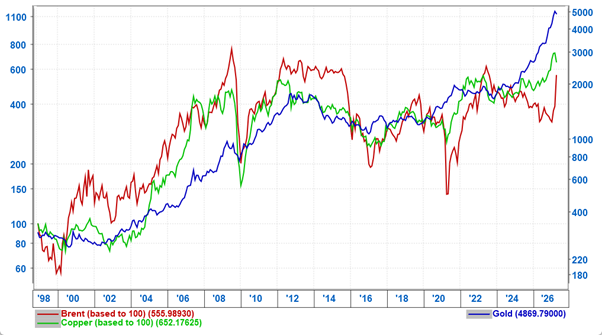
Brent crude oil surged +94% through the quarter, closing the gap with the broader commodity complex, and unwinding the unusual divergence that had characterised 2025. Oil has been strongly correlated to other commodities in past cycles, however that relationship may be questioned in the short term given the magnitude of the supply shock that we are seeing.
Chart 1: Oil has closed the gap to other commodities, reversing the 2025 divergence
Source: IRESS (31st March 2026)
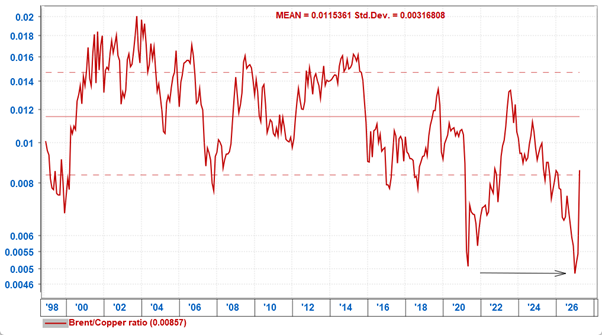
We had identified that oil was priced unsustainably low relative to other commodities coming into the year; the oil/copper ratio entered 2026 at levels last seen during the worst of the Covid lows. That anomaly has now largely corrected.
Chart 2: Oil/Copper ratio entered 2026 at unsustainably cheap levels
Source: IRESS (31st March 2026)
However, the spike in the oil price doesn’t necessarily mean it is over for the super-cycle in broad commodities. The FTSE/JSE Capped Resources 10 Index (RESI Index) still returned +7% for the quarter, with Gold up 8% and copper modestly down 3% (all in USD).
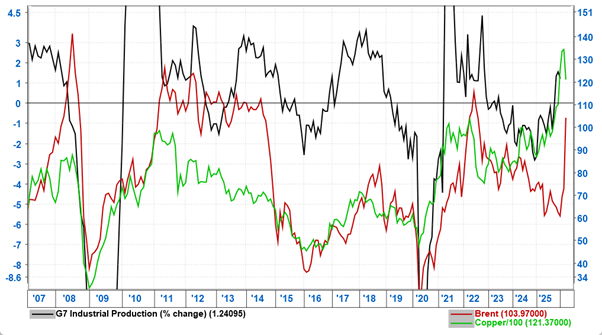
Chart 3: Oil is highly correlated to the industrial production cycle and metal prices
Source: IRESS (31st March 2026)
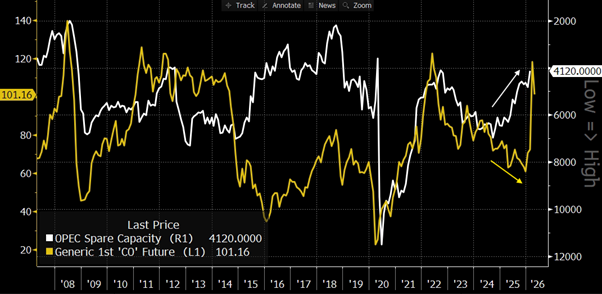
Last year it was observed that decreasing spare capacity in OPEC (ie increasing production) was inconsistent with the falling oil price. Should the crisis in the Strait be resolved, the level of OPEC spare capacity still implies that the oil price could remain higher for longer and certainly above the levels reached in late 2025, especially if the global economic cycle remains intact.
Chart 4: OPEC spare capacity decreased through 2025
Source: BLOOMBERG (31st March 2026)
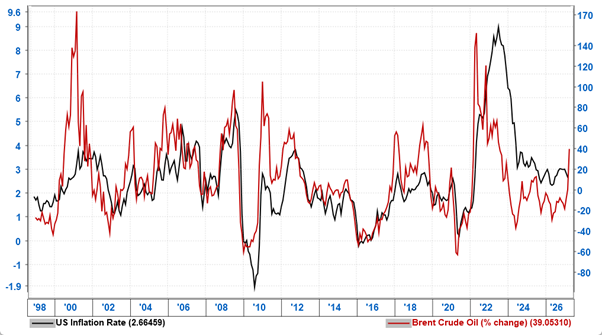
The inflationary impact of higher oil is clear. As the chart below illustrates, spikes in the oil price have reliably fed through into US inflation. This is damaging for bond markets; the US 10-year yield rose +35bps in March alone. The effect on SA bonds was far more severe, with the SA 10-year surging +116bps over the same period, reflecting the country’s particular vulnerability to an oil shock. Our positions in SA interest rate sensitive (IRS) equity hurt performance during the quarter, with the SA IRS basket declining 5% and the ALBI down 3%. 10-year bonds in Brazil and Mexico fared much better, returning 11% and 4% respectively (in ZAR), which helped performance.
Chart 5: Inflation warning signals return (but not yet as extreme as 2022)
Source: IRESS (31st March 2026)
Outlook
The key question is whether there can be a resolution to the Strait of Hormuz crisis. One can’t ignore the possibility that there is prolonged conflict, which includes material attacks on energy infrastructure and ground operations. However, the most likely scenario seems to be a gradual easing of the supply shortfall, based on the overwhelming global interest in keeping the strait open. Iran can retain this key strategic leverage over the US, even if they allow oil flows to resume. That scenario may not involve a permanent ceasefire though, under which tensions remain high and markets will suffer prolonged volatility. Even under the best case ‘de-escalation’ scenario, there is little doubt that oil prices will fall and risk assets will rally, but given how unsustainably depressed oil prices were heading into the year, a full reversal to prior levels is difficult to justify. Critically, in our view if the broader commodity cycle remains buoyant, higher for longer oil prices in themselves may not be too detrimental to markets, especially those that are geared towards commodity exports, for example SA and Brazil
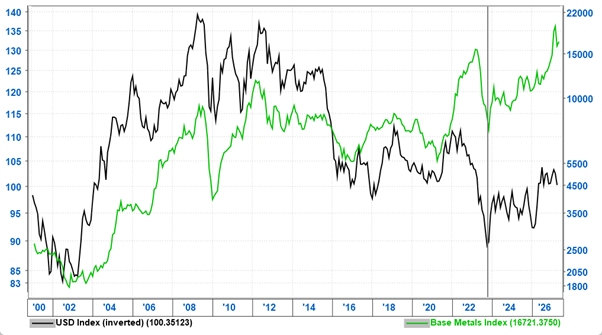
The outlook for the US Dollar is similarly tough. It increasingly looks like we are in a weak dollar cycle, with the turning point reached in late 2022. This has resulted in a strong rally in commodities since then (base metals index plotted in green below). History has shown that USD cycles are typically multi-year events; it appears that the ‘decade of carry trade support’ for a strong USD seen through the 2010’s is over. Carry trades now favour a weaker USD in aggregate, and the USD remains expensive using purchasing power parity against a range of currencies.
Chart 6: Weak USD cycle since Oct 2022
Source: IRESS (31st March 2026)
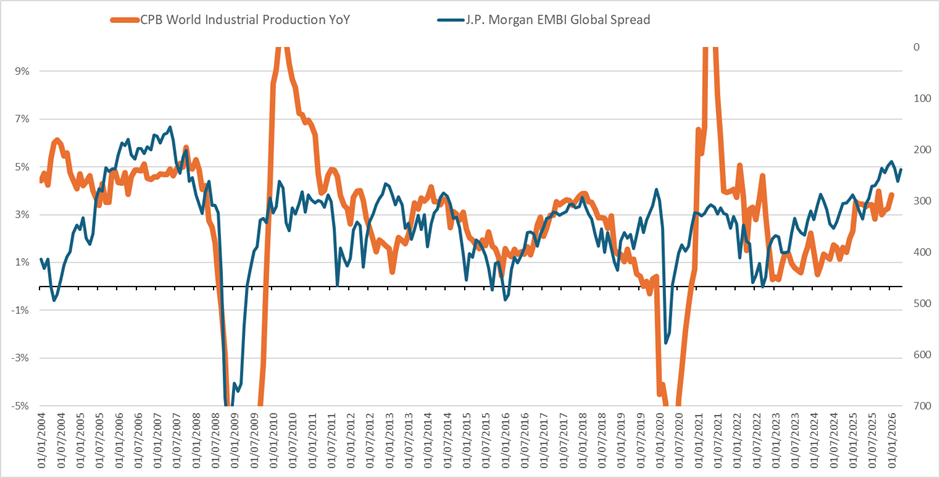
We do acknowledge the mixed signals on the level of cyclical support. A loss of global growth momentum, particularly if the strait crisis worsens, represents a clear and present danger to risk assets broadly, and has tempered our near-term positioning across the funds. We have reduced risk across the funds, primarily by decreasing exposure to interest rate sensitives, but also by taking profits in some of our RESI winners and shifting into energy producers.
Chart 7: Risk assets have followed the global cycle
Source: BLOOMBERG (31st March 2026)
*EMBI = Emerging Market Bond Index
Asset Class Returns
Key Market Takeaways for the Quarter ended
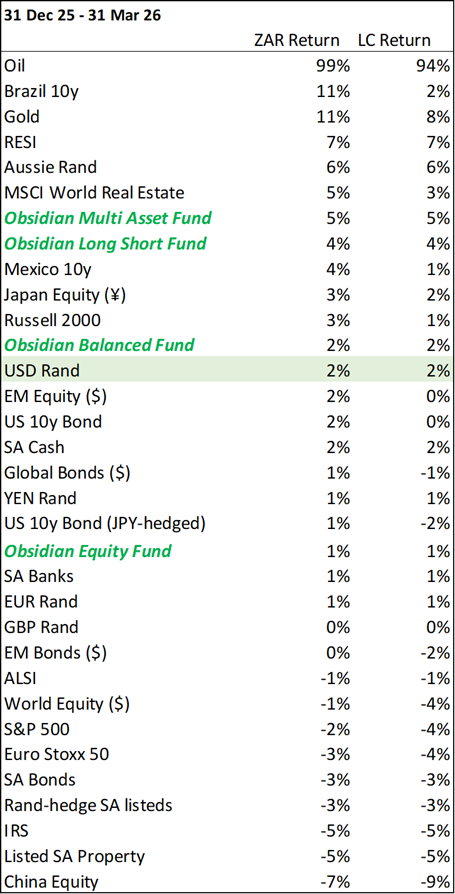
- The South African Rand remained relatively stable against major developed market currencies during the quarter. The USD/ZAR appreciated by 2%, while other crosses showed modest gains or were largely unchanged, with the YEN/ZAR up 1%, EUR/ZAR up 1%, and GBP/ZAR flat at 0%. This stability provided some cushion for local investors in unhedged global assets.
- Developed market (DM) equities broadly underperformed, particularly when measured in local currency terms. Major global indices recorded negative returns in USD, including the MSCI World Equity Index (– 4%), the S&P 500 (– 4%), and the Euro Stoxx 50 (– 4%). The underlying performance of developed markets was clearly weak, reflecting a challenging period for global equities.
- Global and local bond markets delivered mixed results. Global bonds posted modest positive returns in ZAR terms (Global Bond Index +1%), while US 10-year Treasuries and JPY-hedged US 10-year bonds were up 2% and 1% respectively. In South Africa, SA Bonds declined by 3%, whereas selected emerging market bonds performed strongly, led by the Brazil 10-year (+11% in ZAR) and the Mexico 10-year (+4% in ZAR).
- Domestic equities underperformed the broader market. The ALSI returned –1% for the quarter. Rate-sensitive sectors were particularly weak, with the Interest Rate Sensitive (IRS) basket declining 5%, Listed SA Property falling 5%, and Rand-hedge SA listed stocks down 3%. SA Banks provided a modest offset, returning a small positive 1%. Overall, the quarter highlighted ongoing pressure on domestically oriented and interest-rate-sensitive segments of the JSE.
- Gold and resources were standout performers. Gold advanced a strong 11% in ZAR terms, while the FTSE/JSE Capped Resources 10 Index (RESI) gained 7%, materially outperforming the broader ALSI. This performance created a clear divergence: resource-driven stocks delivered solid gains, while interest-rate-sensitive domestic equities continued to lag.
Additional Key Observations
- The quarter was dominated by a sharp oil price surge, with oil rising 99% in ZAR terms. This represents one of the largest quarterly moves in the rand-denominated oil price in decades (the second-largest since the third quarter of 1990). The move provided significant tailwinds for commodity-exposed assets and contributed to the resilience of the resources sector.
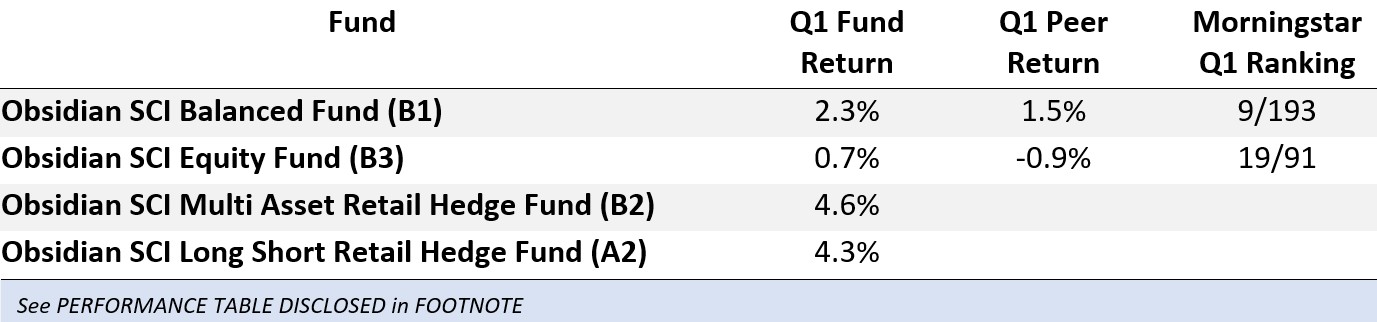
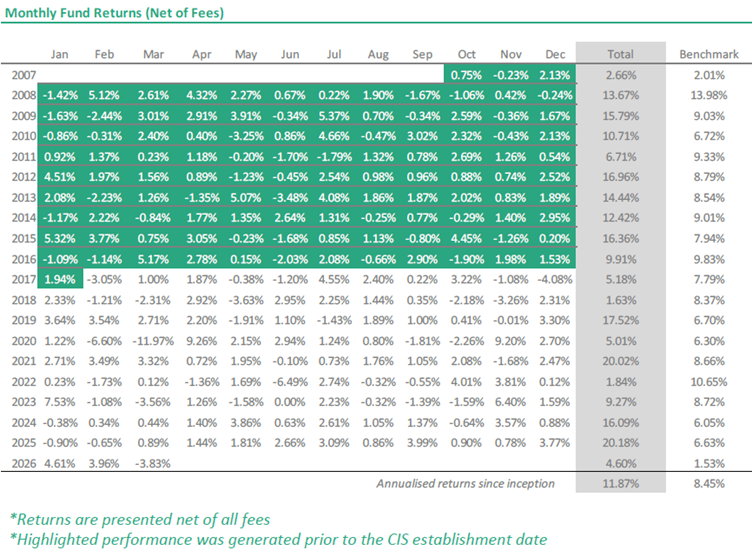
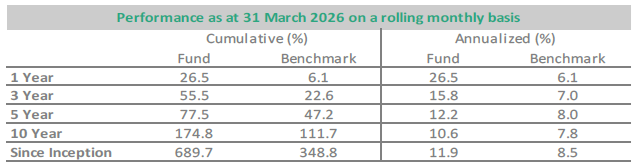
- Obsidian’s funds delivered resilient results in this environment. The Obsidian Multi Asset Fund returned +4.6%, the Obsidian Long Short Fund+4.3%, the Obsidian Balanced Fund+2.3% and the Obsidian Equity fund +0.7%. All four strategies outperformed the ALSI (–1%) and most global equity benchmarks. The outperformance was supported by tactical positioning in Japanese equities (via iShares Japan), selected global names such as Microsoft and Shell, as well as currency exposures including additions to JPY/ZAR and EUR/ZAR.
In summary, the quarter presented a tale of two markets. Strong commodity tailwinds, particularly in gold and oil, contrasted sharply with weakness in rate-sensitive domestic assets (property, broader non-resource equities, and interest-rate-sensitive sectors). Global developed equities and many bond markets offered only limited support, underscoring the importance of selective, active positioning across asset classes and geographies.
Chart 8: Global Asset Q1 returns
Source: Bloomberg (31st March 2026)
Portfolio Changes
From an asset allocation perspective, we still prefer equities to bonds, and emerging markets over developed markets. Within equities, we favour South Africa and emerging markets, but also retain some select DM exposure in Japan, US Tech, and Energy. Our bond exposure is largely in emerging markets that are better priced than South Africa, such as Brazil and Mexico, although we are not negative on South African Bonds in isolation. We also hold slightly more cash than usual in the appropriate funds.
Looking at the sector changes
- The sectors with the largest reductions in exposure were Banks, Asset management, Resources and Tech
- The sectors with the largest additions in exposure were Energy and Telecommunications
|
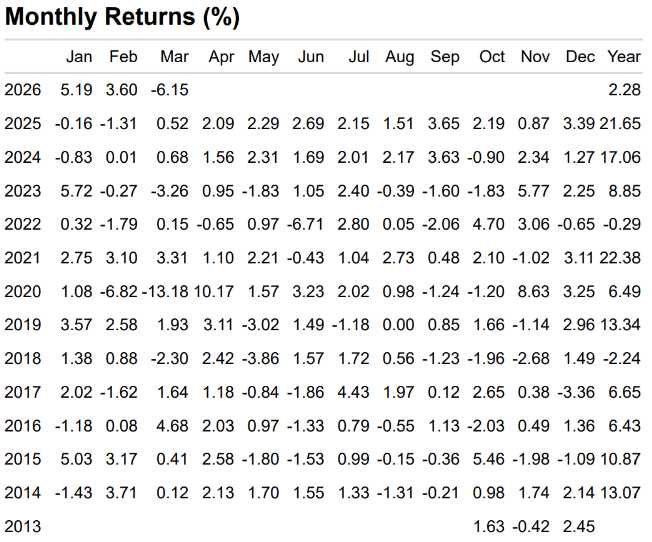
Obsidian SCI Balanced Fund (B1):
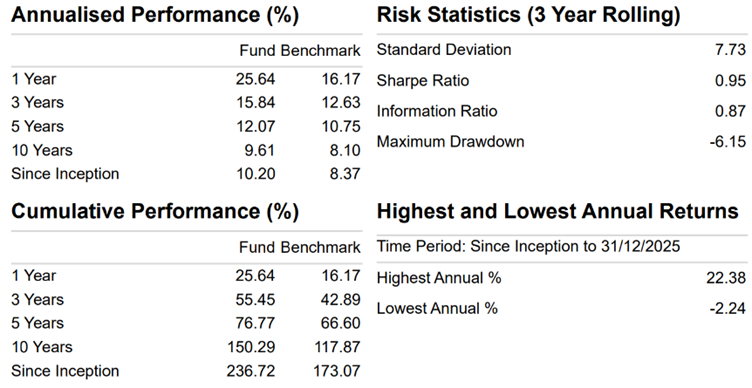
Obsidian SCI Equity Fund (B3)
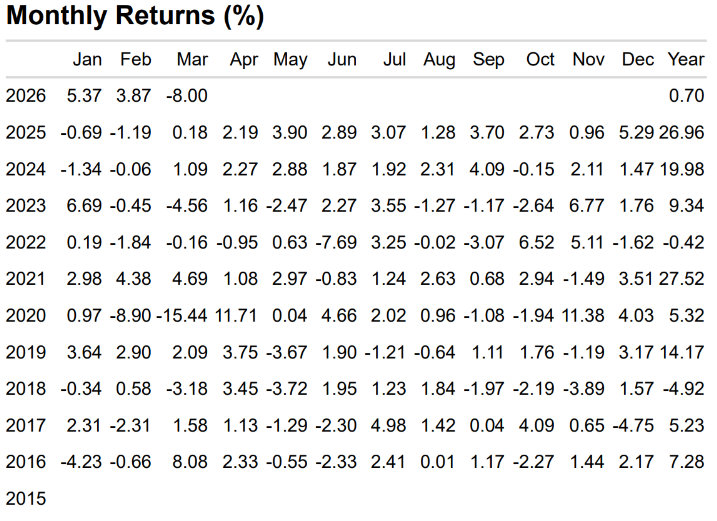
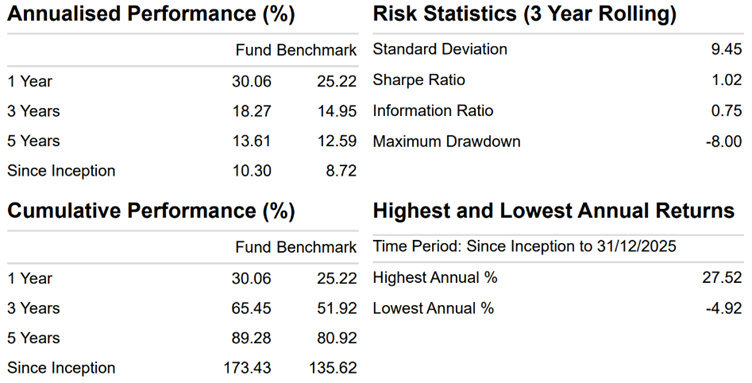
Obsidian SCI Long Short Retail Hedge Fund (A2)
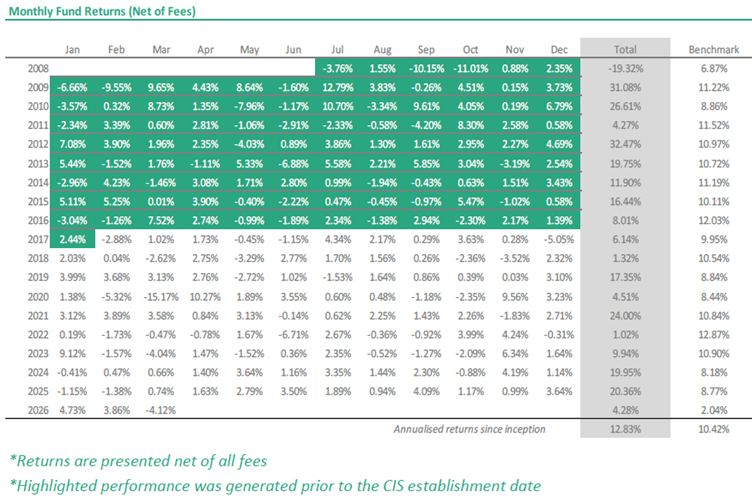
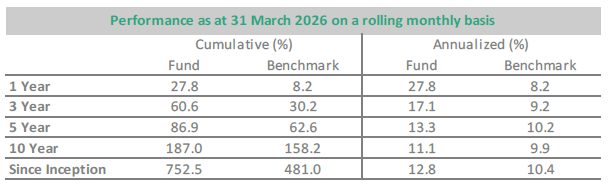
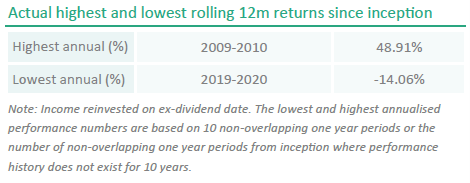
Obsidian SCI Multi Asset Retail Hedge Fund (B2)
Disclaimer: Obsidian Capital (Pty) Ltd (FSP number 32444) is an authorised Financial Services Provider in terms of the FAIS Act.
The information contained in this article does not constitute financial advice as contemplated in terms of the Financial Advisory and Intermediary Services Act, and should be read in conjunction with a minimum disclosure document (MDD) and the Upfront Disclosure Document. Use of or reliance on this information is at own risk. Independent professional financial advice should be sought before making an investment decision.
Sanlam Collective Investments (RF) (Pty) Ltd, a registered and approved Manager in Collective Investment Schemes in Securities. Collective investment schemes are generally medium- to long-term investments. Past performance is not necessarily a guide to future performance, and that the value of investments / units / unit trusts may go down as well as up. A schedule of fees and charges and maximum commissions is available from the Manager on request. Collective investments are traded at ruling prices and can engage in borrowing and scrip lending. The Manager does not provide any guarantee either with respect to the capital or the return of a portfolio. Performance is based on NAV to NAV calculations with income reinvestments done on the ex-div date. Performance is calculated for the portfolio and the individual investor performance may differ as a result of initial fees, actual investment date, date of reinvestment and dividend withholding tax. The manager has the right to close the portfolio to new investors in order to manager it more efficiently in accordance with its mandate.
While CIS in hedge funds differ from CIS in securities (long-only portfolios) the two may appear similar, as both are structured in the same way and are subject to the same regulatory requirements. The ability of a portfolio to repurchase is dependent upon the liquidity of the securities and cash of the portfolio. A manager may, in exceptional circumstances, suspend repurchases for a period, subject to regulatory approval, to await liquidity and the manager must keep the investors informed about these circumstances. Further risks associated with hedge funds include: investment strategies may be inherently risky; leverage usually means higher volatility; short-selling can lead to significant losses; unlisted instruments might be valued incorrectly; fixed income instruments may be low-grade; exchange rates could turn against the fund; other complex investments might be misunderstood; the client may be caught in a liquidity squeeze; the prime broker or custodian may default; regulations could change; past performance might be theoretical; or the manager may be conflicted.
A copy of the Performance fee Frequently Asked Questions can be obtained from our website: www.sanlaminvestments.com. Annualised return is the weighted average compound growth rate over the period measured.